

Prologue
Listen to the fiddler play
when he’s playin’ ‘til the break of day
Oh me, oh my, love that country pie.
Bob Dylan, Country Pie
Installing an outside faucet for the hose proved to be a bigger job than I wanted. The basement walls of the farmhouse we bought were a foot-thick mass of concrete and rocks. Drilling a half-inch hole took most of the morning.
“Yeah, I built those walls,” laughed Jack when I complained to him, “It took some time, too. When we homesteaded this place, we lived in a tarpaper shack for the first three years while I built the house. We blasted the basement out of bedrock. Granite. Pre-Cambrian shield, the oldest rock on earth.
“Then I built the forms for those walls. I mixed concrete one wheelbarrow at a time: 10 hours a day, seven days a week for four months to fill those forms. Would have taken longer if I hadn’t thrown in all the rocks I could find. My wife, Muriel, helped as much as she could, but she had the baby to look after. I stuck to it, though, and finally we had a basement.
“Then we got a bulldozer to push dirt up around the walls. That’s what made that pond in front of the house now. We almost lost the ‘dozer ¾ it was oozing around in that black jellylike muck. Rubbery clay, squirting out from underneath the treads in big flappy sheets. When we hit the springs under the pond, they began filling the hole with water. We got the ‘dozer out just in time.
“When we started the log framing, I had about 10 friends come out from the city to help. Word spread to my neighbour, Asa, who lived a few miles down the road that I was building a house. He came with his two sons in their old station wagon, and in the back of that car he brought 30 pies that his wife had baked for the house raisin’. I guess he expected a bigger crowd.
“We all ate as much pie as we could, about one apiece, and he still had 20 left that he took home with him. I don’t think I ate pie for a month after that.
“We moved in with only the main floor finished and, in some ways, it was the simplest, happiest time of my life.
“One day, though, when I was at work, our daughter crawled over the main floor and fell down the basement stairs and was knocked unconscious. Here was Muriel all the way up here, no car or nothing, she didn’t know what to do.
“One of the neighbours saw her running down the road, crying, with our baby in her arms. She was on her way into town, 15 miles to get help. I guess the isolation was too much for her. She took our daughter and left me as soon as the house was built.”
Sometimes the country was more than I bargained for, too.
He’s got this dream about buyin’ some land
And then he’ll settle down
in a quiet little town
And forget about everything
Gerry Rafferty, Baker Street
We lived in Toronto on a lot 15 feet wide and 100 feet long. Then we moved to a suburban half-acre and our garden was bigger than the Toronto lot, plus we had 25 fruit trees. We also planted grapes, strawberries, raspberries and blueberries, then built a gambrel-roofed two-story shed and playhouse that looked like a real barn that had shrunk in the rain.
Compared to our neighbours, we looked like farmers. We had 20 bales of straw delivered one fall to cover the berries and mulch around the fruit trees. A neighbour wandered over and asked me what it was for. “The pigs,” I replied. He just walked away, then probably called the bylaw officer.
Our dream was to buy some land and build a solar-powered house. We wanted clean air, soil, and water so we could really raise our own animals. My parents measured success by having the money to buy from the store instead of relying on homemade. I measured success by having the time to grow and make my own. We wanted room to stretch out. We have all that, now that we live in Jack’s house, but if we had known how much work it would be, we might never have made the move.
Lots of people dream about moving to the country, but we found that the romantic notion of idyllic rural life and the gritty reality are as far apart as the earth and the stars. There are tremendous rewards from living in the country, especially the way we do, but they come at a price. The country has made me 10 times angrier, more discouraged, tired, and bug-bitten than I ever was before.
We looked at 20 or so properties over three years. The ones we could afford were too small or too close to highways or railroad tracks or transmission lines. Then we found some Goldilocks land on a private lake, far enough away to be quiet, close enough to town to be convenient. No power or phone lines, though; just soil, rocks, and water.
We knew we could make our own power from the sun and wind, but we thought a phone line would be nice until we heard the price for poles and wires - $25,000. We couldn’t buy the property unless we found others to share that cost, so we wrote to everyone living further up the road to see if they might be interested in phone lines, too.
The Goldilocks land fell through, but we received a reply to our letter. A man named Jack wrote back that he would normally be willing to share the cost, but he had put his property up for sale.
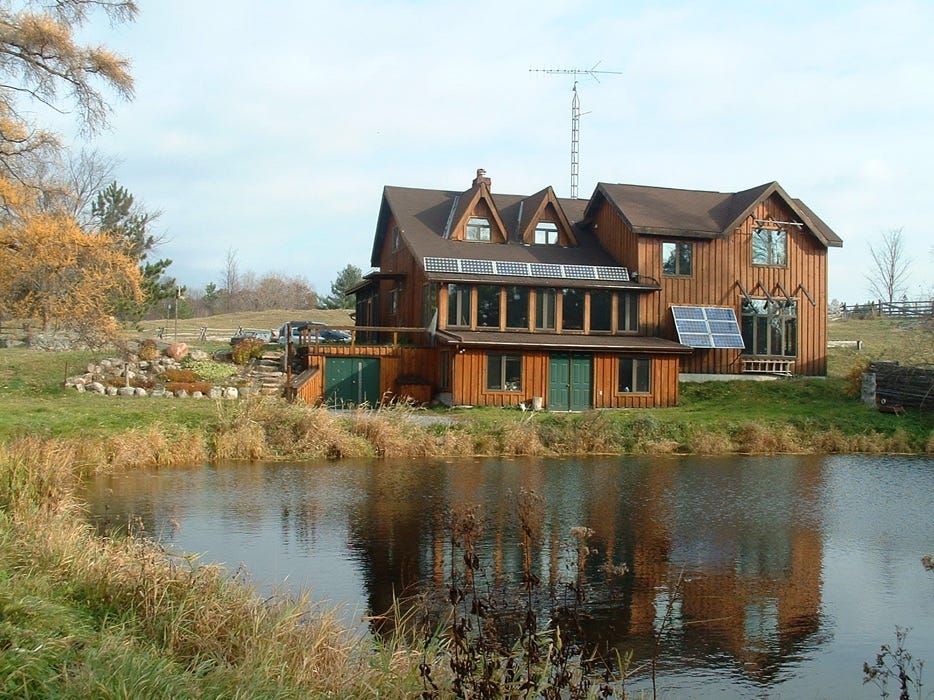
So we went to look at it. It was about the right size, 80 acres, with a good small barn, two ancient log shacks, a human-made pond, and a solar powered house with a foot-thick foundation. One odd thing is that I recognized the barn door from a dream I had. Maybe that was a sign of some sort. After a battery of soil and water tests that all came back clean, we bought Jack’s farm.
Of course, the house needed renovations to accommodate a four-fold population explosion, and we had big plans: another bedroom, a family room, a basement shop extension. We allowed four months and half the equity from our suburban house and we weren’t even close. It took a year and all our equity.
Welcome to the country.
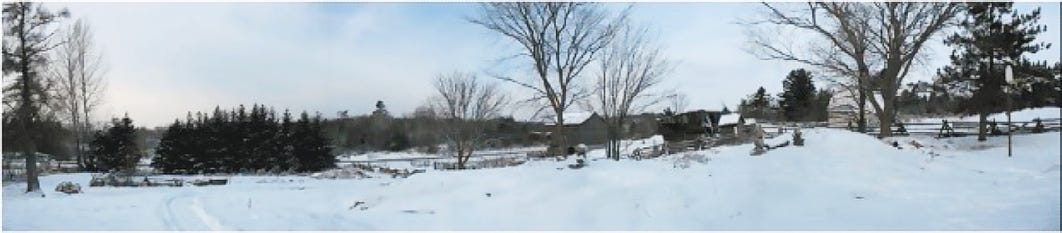
We moved to the land of chickens and chainsaws in November. Snow on the ground and the worst month of the year for solar power production. We all lived in one room amidst boxes stacked head high and arranged to provide a narrow path from the door to the two beds.
The radio telephone specifically designed for remote locations that looked perfect in the brochures didn’t work properly for six months. The power system was hopelessly inadequate for two adults and two children, so we often carried kerosene lanterns and candles around that first dark, cold winter.
My computer wouldn’t work. Weeks of calls to help desks and a parade of technicians couldn’t fix it. The only heat in the house was from an ancient wood furnace in the basement. The only time I was warm was when I was first in the bath, and we all had to take turns because we didn’t have enough power to run the water pump very often.
We had a propane stove that worked well and a propane refrigerator that dropped its freezer door every time we opened or closed it. We cut our own firewood, froze around the tree that first Christmas morning, put plastic on all the upstairs windows, and told each other what fun we were having.
We were, at worst, foolish. At best, optimistic and persistent.
I escaped for two or three days a week to Toronto the first three years, writing enough mutual fund marketing material on Bay Street to bankroll our relapse into the nineteenth century, but my wife Susan, Conor age 11, and Charlotte age 9 when we moved were country mice all the time. While I had a chance to take long hotel showers and leave as many lights on as I wanted, they soldiered on.
In Toronto, I would often go over to my brother-in law’s for a good meal and wine, yet I winced every time Susan called me, wondering what else had broken down this time.
In that first year, our country dream resembled a nightmare and every one of us gave up at least once. I drove four kilometers to the neighbour’s telephone with my laptop so I could communicate with my writing clients. Susan took care of the house, the kids chopped wood and huddled around the kitchen vents above the furnace to do their homework.
By February, Susan and I were able to move to our own bedroom and Conor to his. Charlotte raised her arms in the air and shouted with glee, “Hooray, my parents are moving out of my room.” We skied and sledded and walked on our own land. We saw bear and coyote and deer and osprey. And we slowly made some headway.
I had a three-page single-spaced list of essential projects, and some were getting completed. A kitchen wood stove helped take the frost off the inside of the windows, then we installed a propane boiler with hot water piped through radiators. No more getting up at four a.m. to stoke the furnace or worrying about leaving the house with a fire going.
Next was the power system. Solar power requires panels to generate DC electricity, batteries to store it, and an inverter to turn the DC power into the more common AC current we all use. Renovations and construction were powered by an ancient Kohler propane generator in a block house that the wind roared through, and I spent many hours coaxing it to start and keeping it running with frozen hands, but we couldn’t keep the house batteries charged well enough. We added more panels and a new inverter with a powerful battery charger that ran off a new generator in a tailor-made house snugly built into the side of a hill. We were fine on sunny days, and on cloudy days our generator could now power the house.
Eventually we replaced every major system: heating, septic tank and drain field, new well, refrigerator, windows, water tank and water heater, but we never would have made it without our neighbours. Wesley let us install one end of our radio telephone at his place, and was always there with encouragement, good cheer, and expertise. He is a mechanic of genius. Anything he can’t fix, he can build from scratch better than the original. He sold us a good truck with a new Lincoln engine, fixed the tractor and snowblower, kept our cars running, and was always willing to help with the generator, water pump, or chain saw. In the spring we turned our attention to outside, and I bought books on chickens, pigs, sheep, and cattle.
We cleaned up piles of rubble in black flies so thick I couldn’t breathe. We took a truckload of old newspapers and a truckload of metal to the recycle depot. We got an old ambulance from Wesley to use as a chicken coop and bought Barred Plymouth Rock chickens for our own fresh eggs. We reorganized one of the sheds for White Rock meat chickens, found Major, a great black Labrador dog, at the Humane Society and barn cats along the road.
This was more like it. One sunny morning I was sitting on the ground next to the chickens’ outside run, listening to their gentle ta, ta, ta, when I realized we were in the middle of our dream. I was so pleased, I dozed off right there. We planted a main garden, a berry garden, and a kitchen garden. We plowed a field and planted corn. Plowed another spot and planted walnuts from our tree in the front yard. We bought sheep, cattle, and pigs.
That started when I mentioned to Wesley that I didn’t think you could really live on a farm without having pigs.
He put down his wrench. “I’ve kept pigs from time to time and there is no more stubborn critter in the world than a pig. My Uncle Berk says they are the only critter with their head on backwards. You want them to go this way, and they go that way, that’s for true. I was loading pigs one day and a 400-pound sow didn’t want to get into the truck. Instead, she went right through the barn window, four feet off the ground, broke all the glass out of it. We chased her around the yard for an hour trying to get her back in the barn. We finally roped her and dragged her back with the pickup, kicking and squealing. She made a furrow a foot deep across the yard where she braced her feet against that truck. Good thing I got four-wheel drive, or I doubt we could have pulled her.
“Another time I had a boar inside and a sow in heat outside in a pen made from four-foot pallets half buried in the ground, then a second row of pallets lashed on top of them. That made a fence six feet high.
“Well, this sow kept getting out and trying to break down the door to get to the boar inside. I thought there was a hole in the fence somewhere, so I went around and around that fence looking for the hole. Couldn’t find one.
“Then I was standing in the kitchen one morning and I saw her hoist herself up and over that fence. She just climbed those pallets like you would climb a ladder, up and over. The only difference was that she weighed twice as much as you and had shorter legs.
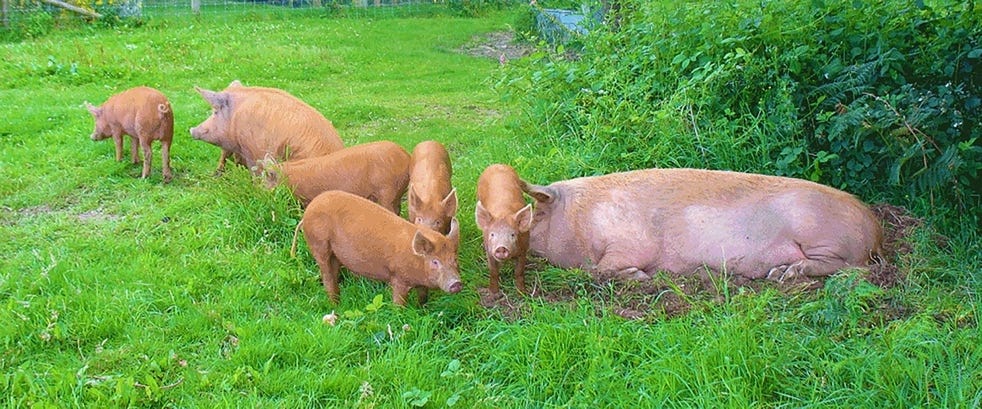
“That’s the only time I’ve seen a pig go up and over. Usually, they go under. A regular fence is no good, they will get their nose under it and lift fence posts right out of the ground. The best thing is electric, turned up high. Pigs are smart, some say smarter than dogs, and if you can train them when they’re young, they won’t try to go through an electric fence later, even though they could if they wanted to.”
We followed his advice in an old corral in front of the barn that was fenced all around with six foot-high page wire; heavy checkerboard strands about six inches apart. We put up one solar panel, added ten more batteries, and hooked up an electric fencer to jolt those porkers if they got too close.
The kids went with me in the pickup to a local pig farmer to get the piglets. On the way, I had Conor read me the part of the pig book that covered buying piglets.
“A 30 to 40-pound pig should be six to eight weeks old,” Conor read, “A 30-pound pig ten weeks old is a runt and may always grow slowly. The animal you buy should be active with clear eyes and not sneezing or wheezing. It shouldn’t shake or limp when walking. It shouldn’t be skinny, or flat-sided with an end-on appearance of a loaf of bread.”
“Yeah, I don’t think we should buy a loaf of pig,” Charlotte giggled Conor gave her a stern look and went on, “Watch out for swollen joints and abscesses. Be sure to check that they don’t have a bulge beneath their bellies or in the groin, that indicates a hernia. Pinch an ear gently to make sure there is no delay in blood flowing back quickly that could indicate anemia. Eyes should not be dull or sunken. Avoid a pig with drooping head or tail.”
I was ready to avoid the whole business.
I asked the farmer for four pigs with some color on them. He glanced at me out of the corner of his eye, then went in his barn. There was scuffling and squealing, and he came out with a red piglet in his arms.
I checked the belly, legs, and eyes and put it in the truck. We added a white pig, a Hampshire-looking pig with a black band all around its middle, and a spotted pig. Easy to tell apart.
On the way back, we talked about names. I had been warned not to let the kids name anything they were going to eat, so I favoured naming them for cuts of meat.
We finally settled on Pork Chop for the white, Hammy for the spotted, Hickory-Smoked for the black-banded, and Peameal for the red.
Four months later I looked at our hogs, now 300 pounds each. Back in the days when most people had pigs, it wasn’t unusual to hear of a farmer who slipped in the mud or fainted in the pigpen, then was trampled and eaten by his pigs, and more than one farm family has sat resting on the porch in the evening breeze and seen an old hog run by with a child’s arm in his mouth.
While I was standing there, Charlotte came up behind me and warned, “Now Dad, don’t get too attached to those pigs. You know we’re going to kill them.”
So much for her attachment.
Then it was sheep. Nothing cleans pastures like Blackface. They are used to grazing and browsing on next to nothing in the Scottish highlands. We kept one pasture ahead of them the first year, cutting out thickets of wild cherry that, some say, are toxic to sheep.
When they are little, they are a pain in the neck because they disregard split rail fences, wriggling under and crashing through in some places, but they require little care otherwise. I never used to like lamb until we started raising our own, and I think the wonderful taste is a combination of the Blackface genetics, clean pastures, and Susan’s skill in the kitchen.
Herefords are teaching us about cattle, and we will have our own beef, lamb, poultry, and eggs with no pesticides, no antibiotics, no growth hormones. Plus enough to sell, custom cut and wrapped, to our customers. With that and our gardens, we complain about all the work, but we do fine.
Well, I’m learning.
It’s peaceful here with a good dog and sun and trees.
Out of touch with the breakdown of this century.
They’re not going to fix it up too easy.
Joni Mitchell, Electricity
We use one-fifth of the power of the average city home by combining conservation with energy efficiency. Visitors to our house who don’t notice the solar panels never dream that we are off the grid.
We have everything a city house has except air conditioning and a microwave. We don’t pay monthly electric bills or contribute to the pollution of gas, oil, coal, or nuclear power plants. We considered adding a wind generator for the winter, but Conor will soon be off to college and one less teen-aged boy should cut our electricity consumption by at least one third.
We sit on the screened porch at night in the summer and watch the sunset, then the stars in the sky. A group of local astronomers who frequently set up their telescopes in our pasture tells us this is one of the best night sky locations south of Sudbury, now that light pollution has increased three-fold in the last five years.
We skate on our pond in winter and in the summer watch wildlife ranging in size from mink to deer. We see coyotes, owls, hawks, beaver and sign of moose and bear.
I don’t dread calls from Susan anymore. But one April she told me a frightening tale. If she hadn’t been calm and strong, she would have drowned alone. Here’s her story.
“A crack signaled the invasion, like someone hitting the water with a canoe paddle as hard as they could. A beaver swam in the open water just beyond the sheet of ice that still covered two thirds of the pond. I watched him disappear under the ice and finally reappear in the same spot at the edge of the pond near the house.
“Major ran around the pond sniffing wildly. He ran across the ice from the far (thicker) side to about the middle, then hit the thin spot. Plunk, he was through the ice and into the water. He paddled to the edge of the hole and got his front paws up, still digging with his rear feet but he couldn’t get out. He kept trying to get up, and falling back, as the ice broke under the weight of his front legs. He started whimpering.
“I ran to the edge of the pond and called him, trying to encourage him to fight his way out, but he wasn’t making much headway. I grabbed some big rocks and pelted the ice in front of him to try to break the ice out of his way. They were a drop in the bucket. So, how to clear a path for him?
“I wished we had a boat to get out to him. I thought he was looking tired. The only way I could see was to wade out there. On April 9, the water is still cold. So, I grabbed Steven’s chest waders and jammed them on over my jeans and t-shirt. Armed with the splitting axe, I waded into the pond and began to chop a path through the sheet of ice. I was glad I had decided on the heavy axe, as the ice was still thick in spots.
“I was almost to Major and the water was getting deeper. The only way I could reach him was to continue into shoulder-deep water that now flowed over the top of the waders. It was good and cold. Suddenly I was floating on top of the water struggling with the axe. I’m not sure how my feet left the bottom. I don’t know whether I lost my footing or if I was trying to get up out of the chill.
“Major swam past me and headed for shore. Mission accomplished. At least he was safe.
“Now to save me. My first thought was, “This is how people drown, when their waders fill with water.” Scary. I foundered for a while, then drove my feet to the bottom, stood up and waded to shore. The axe was heavy and the waders were full. I stood on the bank for a moment contemplating the experience.
Steven and our neighbour, Wesley, were going to give me shit for wading in by myself. But, it was either that or watch the dog struggle endlessly. I didn’t think he could get out on his own. And I hoped I could get to him before the water hit the tops of my waders. That was one way to measure the depth in the middle. I realised that was the first and only time I had been IN the pond.
“I peeled off the waders with some difficulty and dumped them out on the grass. I squeezed some water out of my shirt and took off all my clothes in the workshop. I was a little chilly. Good thing that pond wasn’t the temperature of Beaver Lake.
I went upstairs intending to take a hot shower when I realised I had been about to phone my friend Sandy to tell her I was coming to visit. I told her the story and she whistled. “That’s how people drown in the spring, doing exactly that!” she said. Yes, it was an exciting adventure, but it was good to laugh about it with Sandy.
“Into the shower and dry clothes. When I went downstairs to hang the waders from the rafters to dry, I found Steven’s fly-fishing vest on the floor. It must have fallen off when I plucked the waders from the peg. As I picked it up, I noticed a strong smell of citronella. Sure enough, the insect repellent bottle in the pocket had popped open and soaked one side of the vest. I took everything out - pliers, lures, sinkers, bobbers, leader, tippets - and washed the vest in soapy water and hung it out on the line. It will have to stay there for a week to dissipate that pungent smell. Even his idea notebook was soaked, with the writing blurred. I sure hope he has incorporated all of those thoughts into stories.
“For the rest of the day, I could smell the faint odour of citronella, even from upstairs. Now that smell will forever remind me of my swim in the pond.”
Our country adventure has been hard on us and good for us. We all know a great many more skills than when we moved here, but we almost didn’t make it.
This life is not necessarily for everyone, I hope, because we don’t really want a lot of neighbours. In the heat of the summer when something needs repairing, or in the icy winds of the winter when hauling water to the animals seems an insurmountable chore, we don’t have anyone to blame but ourselves. We are living our particular dream.
This spring, Susan and I were planting the garden while Charlotte was filling a water tank for the lambs and chickens with a garden hose. I didn’t see her by the tank and called out, “How are you doing?” She popped out from behind one of the sheds and said, “I was petting kittens and feeding the lambs some grass.”
That’s why we moved here.
We still need off-farm income, and I continue to write for corporate and advertising clients, plus stories like this, but we’ve made the shift from being city mice to country mice. Not without help and hardship and many, many things that we would have done differently, but with a much keener appreciation of sun and rain and land and the rhythm of the seasons.
There once was an owl sitting on a shed,
Fifty years later the owl was dead.
Fifty by fifty the years go by,
Corn keeps best when it’s cool and dry
Fifty by fifty and one by one,
Night begins when the day is done.
Some say mice are in the corn,
Some say kittens are being born.
Some say a kitten becomes a cat,
Mice are likely to know about that.
Some cats are scratchy and some are not,
Corn grows best when it’s damp and hot.
Owl on the shed and mice in the corn
And cats in the clover it all starts over and
Fifty by fifty and one by one
Night begins when the day is done.
Eric Nagler
Decade on the Farm is available on Amazon. Direct link at www.moorepartners.ca